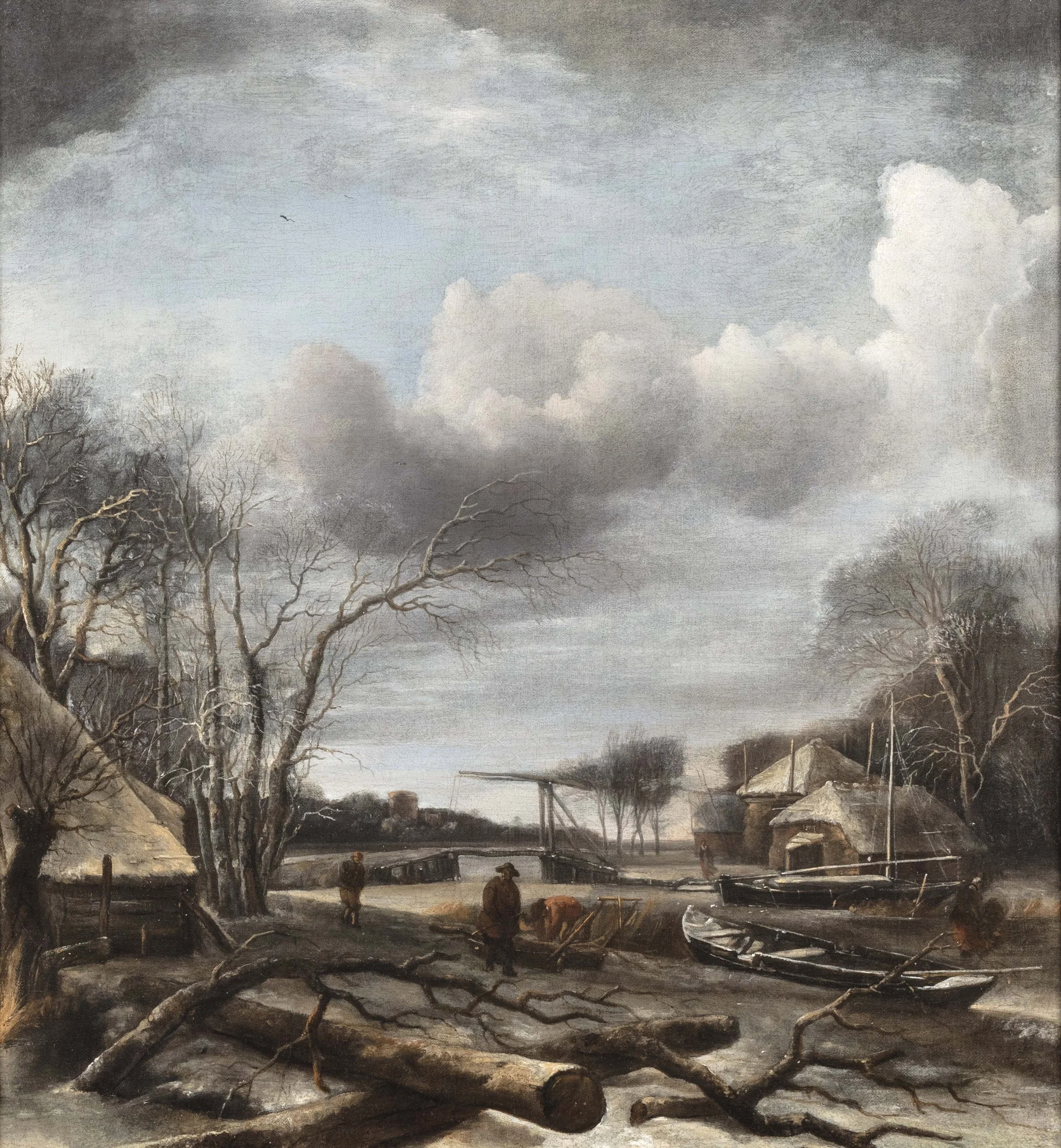
JAN VAN DE CAPELLE (Amsterdam 1625/6 – 1679)
A Winter Landscape with Figures
signed with initials JVC on the end of the tree trunk in the lower center
oil on canvas
19.7 x 16.9 inches (50 x 42.9 cm.)
PROVENANCE
Hendrik Muilman van Haamstede, Amsterdam (1743 – 1812)
Estate of Hendrik Muilman, Van der Schley, Yver, Ross and de Vries, Amsterdam, April 12-13, 1813, lot 22, where bought by
Gruiter
Arthur Kay, Glasgow
Arthur Kay sale, Christie’s, London, May 11, 1901, lot 18, where sold to
Wall
Prince Johann II of Liechtenstein, acquired in Amsterdam (1840 – 1929) and thus by descent in the family to
Hans - Adam II, Prince of Liechtenstein
Liechtenstein Princely Collection, Sotheby’s, London, July 7, 2011, lot 198
LITERATURE
“Sales” The Athenaeum , Athenaeum Press, London, May 18, 1901, p. 637
“The Week’s Art Sales” in The Art Record, May 25, 1901, p. 216
“Aus der Liechtenstein galerie” in Monatsblatt des Altertums – Vereines zu Wein, nos. 7 & 8, July – August 1909, p.105
Algernon Graves, “John Van de Capelle” in Art Sales, volume III, Chiswick Press, London, 1921, p. 264
C. Hofstede de Groot, A Catalog Raisonné of the Works of the Most Eminent Dutch Painters of the Seventeenth Century, volume VII, Macmillan, London, 1923, p. 199, no. 147; p. 203, no.163a; p. 208, no. 178
Dr. A. Kronfeld, Führer Durch die Fürstlich Liechtensteinsche Gëmaldegalerie in Wien, Kunstverlag Wolfrum, Vienna, 1931, pp. 176-177, no. 883
Meisterwerke aus den Sammlungen des Fürsten von Liechtenstein, Kunstmuseum Luzern, 1948, p. 44, no. 183
Höllander des 17. Jahrhunderts, Kunsthaus Zurich,1953, p. 35, no. 22
Wolfgang Stechow, “Winter” in Dutch Landscape Painting of the Seventeenth Century, Cornell University Press, New York, 1966, p. 204, fn. 48 (“another beautiful picture … the Liechtenstein Collection”)
Margarita Russell, Jan Van de Cappelle, F. Lewis Publishers, Limited, Leigh-on-Sea, 1975, p. 83, no. 147, illustrated, fig. 93
Reinhold Baumstark, Masterpieces from the Collection of the Princes of Liechtenstein, Hudson Hills Press, New York, 1980, p. 92, illustrated, p. 224, no. 92
Distant Prospects: Landscape Painting from the Collection of the Prince Von and zu Liechtenstein, Liechtenstein Museum, Vienna, 2008, p. 50, illustrated, fig.47
EXHIBITED
Glasgow City Museum and Art Gallery, 1905
Amsterdam, Frederick Muller & Co., 1907, no. 3
Lucerne, Kunstmuseum, Meisterwerke aus den Sammlungen des Fürsten von Liechtenstein, June 5 – October 31, 1948, no. 183
Zurich, Kunsthaus, Holländer des 17. Jahrhunderts, November 20 – December 20, 1953, no. 22
Jan van de Cappelle “was a prodigy, whose own dated pictures range from as early as 1644 … to 1663” … “Considered the outstanding marine painter of 17th century Holland” he was self – taught. It is believed that he was able to achieve such mastery by rigorous practice from an early age along with guidance from established marine artists in Amsterdam. Both Simon de Vlieger and Willem van de Velde the Elder appear to have been influential. His father owned a successful dye-works in Amsterdam where Jan also worked and later inherited. He became extremely wealthy and amassed one of the most important art collections of the period.[1]
His known oeuvre is fairly small consisting of fewer than 150 paintings. Although primarily a marine artist, he also executed winter scenes of which approximately twenty are known. They range from 1652 – 1654.[2]
In this work Van de Cappelle has rendered an elemental view of winter in the Netherlands of the seventeenth century. Sparsely inhabited, three men and two women contend with the cold even though their sledge is broken and their boats are frozen in the ice. The foreground is filled with bent and felled trees. On either side of the icebound river are thatched roof cottages and bare trees. The midground is marked by a wooden bridge beyond which the river opens up into a wide expanse. Overhead a blue sky is being overtaken by storm clouds, but in the far distance culminates in a vivid pink sunset. The overall beauty of the season is conveyed by the snow encrusted branches of the upright trees and the illumination cast by the blanketed ground and ice.
The Liechtenstein Princely Collection originated more than four hundred years ago and today constitutes one of the most important privately held collections in the world. The Van de Cappelle was purchased by Prince Johann II (1840 – 1929), an avid collector as well as an art historian. He was further advised by Wilhelm von Bode, a scholar of Dutch seventeenth century paintings as well as the Director General of all Prussian museums from 1906 – 1920.