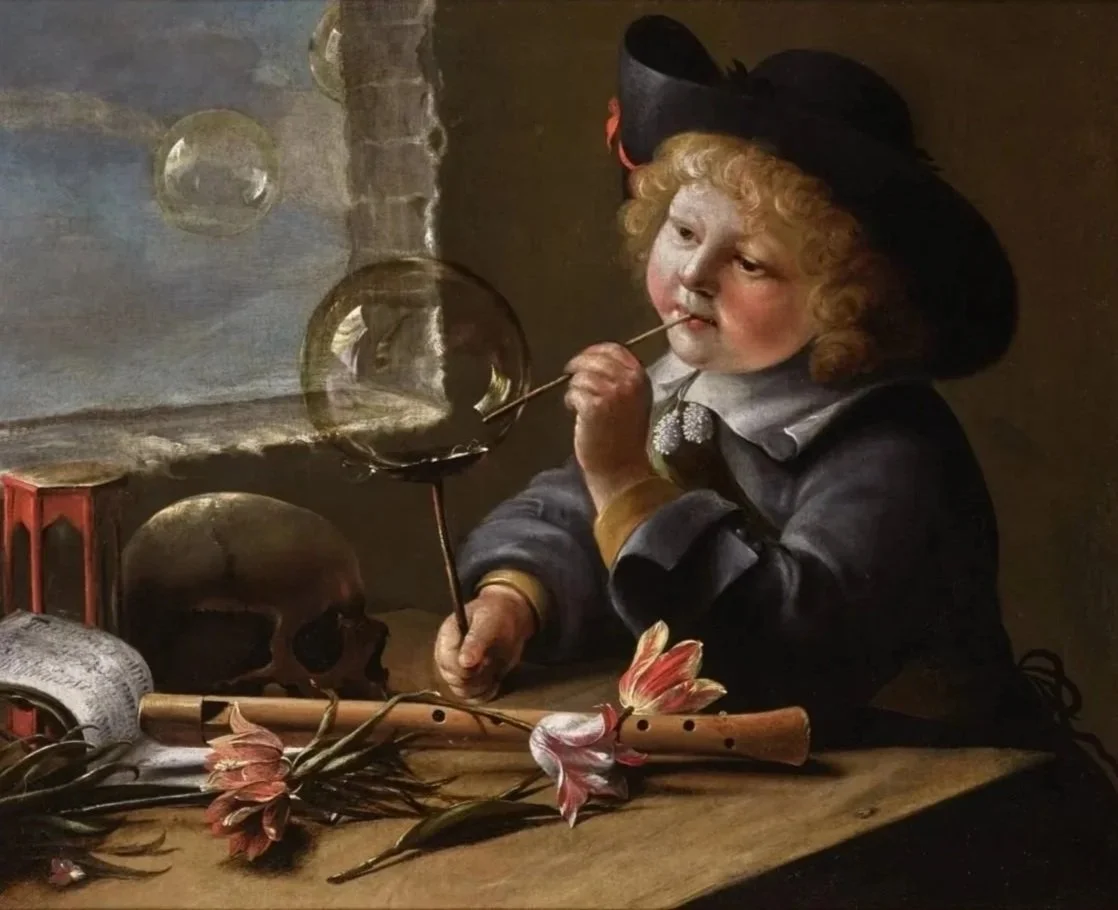
DORDRECHT SCHOOL, circa 1650
A Young Boy Blowing Bubbles
oil on canvas
23.2 x 28.34 inches (59 x 72 cm.)
“The notion of the end of the world and the impermanence of life has been prevalent in philosophy and art since the Middle Ages. Artists across Europe devoted themselves to the theme during the seventeenth century”. At this time in the Northern Netherlands, it was particularly favored.[1]
Believed to have been painted in Dordrecht around 1650[2], a young boy is viewed by an open window depicting a night sky, contently blowing bubbles. The bubbles are blown using a hollow straw and a shallow bowl or large seashell to hold soapy water. Still popular with children today, in the seventeenth century it was a common amusement. Yet in association with the other objects strewn around the table on which the boy leans, it further represents the vanitas motif of a “Homa Bulla” (Man is like a Bubble) and refers to the fleetingness of life.[3]
Rarely are so many other vanitas symbols depicted in the portrayal of a young child. The most overt symbol is the skull close to his right hand, flanked by an hourglass whose sands will soon run out. The flute and music book produce songs and notes “which like time are fleeting and transitory”.[4] The brevity of flowers’ blooms and human life had long been associated. The tulips strewn about are clearly dying and will soon fall apart. They further recall the folly of “Tulipmania” which started in 1634 and engulfed the Netherlands. Fortunes were spent in speculation on individual tulip bulbs until the market crashed in 1637 which lead to bankruptcies and impoverishment. They are a clear warning against the single minded pursuit of worldly goods.[5]
The startling juxtaposition of a young boy surrounded by symbols of transience serves to underline the poignancy of the painting’s message as well as its fundamental truth. [6]
[1] Christiaan Vogelaar, “David Bailly & Vanitas” in David Bailly Time, Death and Vanity, Museum de Lakenhal, Leiden, 2023, p. 71.
[2] Based on statements made by Dr. Fred G. Meijer and Drs. Sander Paarlberg, Curator of Old Master Paintings, Dordrechts Museum, upon viewing the painting November 2025.
[3] Wayne Frantis, Dutch Seventeenth Century Genre Painting, Yale University Press, New Haven, 2004,
p. 112; and Donna R. Barnes, “Children’s Playful Pleasures” in Childhood Pleasures, Dutch Children in the Seventeenth Century, Syracuse University Press, 2012, p. 10.
[4] Karyn Esielonis, Still Life Painting in the Museum of Fine Arts, Boston, 1994, p. 70.
[5] Sam Segal, A Prosperous Past, The Sumptuous Still Life in the Netherlands 1600 – 1700, SDU Publishers, The Hague, 1988, pp. 77-78, 84; and Raymond J. Kelly, III, To Be, or Not To Be, Four Hundred Years of Vanitas Painting, Flint Institute of Arts, 2006, p. 23.
[6] Raymond J. Kelly, III, “Bartholomeus van der Helst, Homa Bulla: A Boy Blowing Bubbles in a Landscape” in To Be, or Not To Be, op.cit., p. 70.