JACOB VAN ES (Antwerp fl. 1616/ 1617 – 1666)
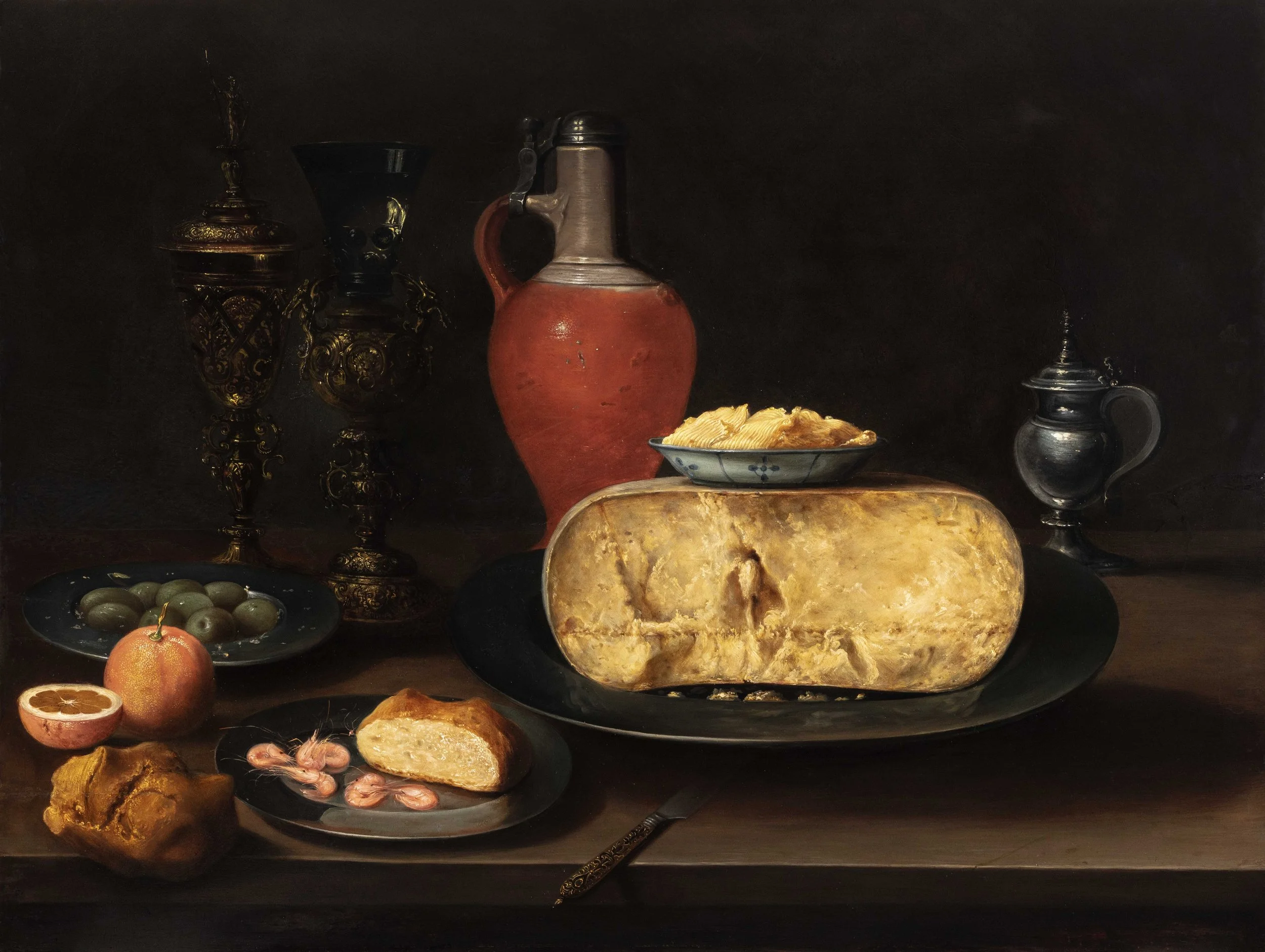
A Still Life with Cheese, Butter, Bread, Prawns, Oranges, Olives and Wine on a Table
oil on panel
23 ½ x 31 ¼ inches (60 x 80 cm.)
This spectacular painting was done by Jacob van Es at the start of his career. At the heart of the composition is a half wheel of yellow cheese on a pewter platter topped by a shallow Chinese bowl holding shavings of butter. The production of cheese was an important industry in seventeenth century Holland, widely exported, popular in Flanders, and as such a common and inexpensive food. On the other hand, butter was a luxury, and when eaten together regarded as an “excessive delicacy”.[1]
To the right of the cheese is a silver mustard pot, “a favorite condiment in the Netherlands”.[2] The protrusion of the knife over the edge of the table in front of the cheese, is an early device used to add three–dimensionality to the scene, breaking down the picture plane and inviting the viewer to partake of the refreshments on hand.[3] To the left of the knife are rolls and prawns. Both were considered luxury items, in particular white rolls were costly with whole wheat or rye bread the standard fare.[4] The nearby oranges and olives represent further extravagances as they had to be imported from areas around the Mediterranean.[5] Just behind the platter of olives is a magnificent golden goblet with an ornate lid paired with a roemer held in place by golden dragons from a bekerschroef or cupholder. The prunts on the base of the roemer provided a grip so it could not slip through wet fingers when held.[6] The red stoneware jug to the right is representative of more common ware. The mixing of high and low objects as well as food, combined with a simplicity of composition and restrained coloring, coalesce to create a visual feast of perfection.
Van Es became a master in the Guild of St Luke of Antwerp in 1616 - 1617. There is no record of his apprenticeship, and it is thought that he was possibly of Frisian descent. He devoted his practice to the painting of still lives, mainly breakfast and banquet pieces and flowers. His entire career was in Antwerp, but it is thought that he traveled to Rome in 1636. He is recorded in numerous 17th century inventories of Antwerp collectors, a statement to his success. At the time of his death Rubens owned two of his works. Two apprentices are documented, Jacob Gillis (1621/1622) and Jan van Thiel (1623). He had four sons, one of whom joined the Antwerp Guild in 1648, but which one is unknown. Although Van Es had a career that spanned 50 years, somewhat over 100 still lives are known, leading to the conclusion that a considerable number were lost over the centuries.[7]
When the painting was executed Osias Beert I, Clara Peeters and Van Es were the leading exponents in Antwerp of this type of still life that individualized objects and food in simplistic arrangements and settings.[8] By stripping the work down to its essentials, a sense of modernity was instilled as well as the element of timelessness. Edith Greindl, in her landmark book Les Peintres Flamands de nature morte au XVIIe siècle, succinctly described Van Es’ output as “la simplicité constitutue la grandeur” (greatness in simplicity).
A painting by Van Es of a comparable composition is in the National Museum, Stockholm. Shared elements include the red stoneware jug (which reappears in many of his other works) the same bekerschroef, the centrally positioned cheese and butter, roll, whole and sliced orange as well as a similarly positioned knife.
We would like to thank Dr. Fred G. Meijer for confirming this to be an early work by Jacob van Es upon viewing.
[1] Ildiko Ember, “Still-Life Paintings: The Hidden Meanings” in Delights for the Senses, Dutch and Flemish Still-Life Paintings from Budapest, Museum of Fine Arts, Budapest & Leigh Yawkey Woodson Art Museum, 1989, p. 24.
[2] Peter G. Rose, Delicious December, How the Dutch Brought us Santa, Presents, and Treats, Excelsior Editions, 2014, p. 97.
[3] Pamela Hibbs Decoteau, Clara Peeters, Luca Verlag, Lingen, 1992, p. 32; and Peter C. Sutton, “Willem Kalf” in Dutch and Flemish Paintings, The Collection of Willem Baron van Dedem, Frances Lincoln Limited, London, 2002, p. 147.
[4] Henry D. Gregory, “Narrative and Meaning in Pieter Claesz’s Still Life” in Pieter Claesz, Master of Haarlem Still Life, exhibition catalog, Frans Hals Museum, Haarlem, November 27, 2004 – April 4, 2005, p. 99.
[5] Julie Berger Hochstrasser, Still Life and Trade in the Dutch Golden Age, Yale University Press, New Haven and London, 2007, p. 70.
[6] Ibid, pp. 82-83.
[7] Fred G. Meijer, “Jacob Foppens van Es” in The Collection of Dutch and Flemish Still Life Paintings Bequeathed by Daisy Linda Ward, Waanders Publishers, Zwolle, 2003, pp.204-205; and “Jacob Fopsen van Es” at nationalmuseum (Stockholm) on collection nationalmuseum.se.
[8] nationalmuseum (Stockholm), op.cit.