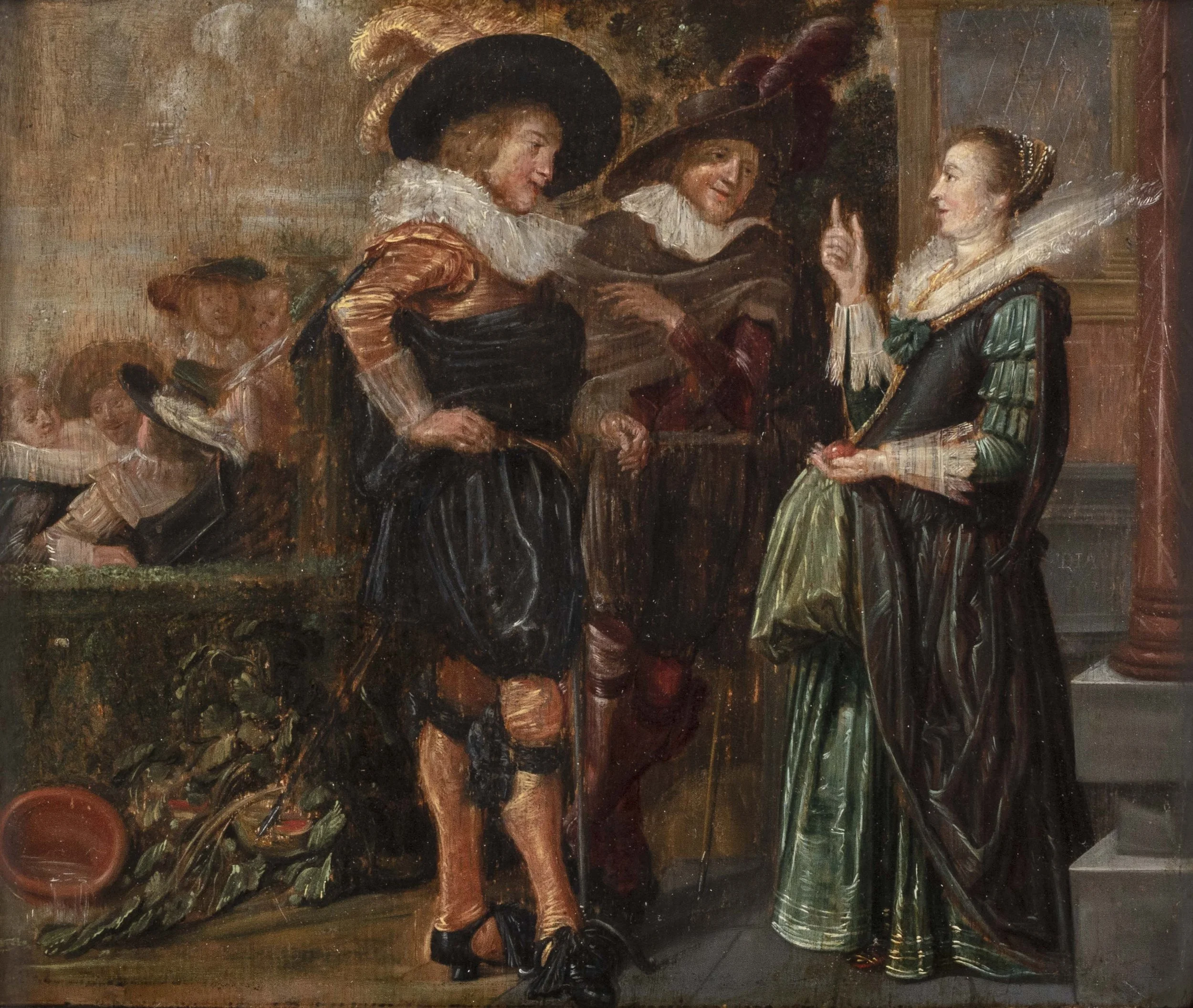
DIRCK HALS (Haarlem 1591 – Haarlem 1656)
The Warning
signed and dated DHALS (with the initials conjoined) 1623 at the bottom of the wall
on the right side
oil on panel
9 x 11 inches (22.9 x 28 cm.)
PROVENANCE
Dr. F. Graefe, Hotel Vier Jahreszeiten, Weisbaden, Germany, by March 1912
August Thyssen, Duisburg, Germany
August Thyssen sale, Important XIII – XIX century paintings, American Art Association, Anderson Galleries, New York, April 28, 1938, lot 35, illustrated (sold with a certificate from Dr. Hofstede de Groot)
Kunsthandel D. Katz, Dieren, The Netherlands, 1938
Anonymous sale, Christie’s, New York, January 15, 1985, lot 181, illustrated (mistakenly catalogued as dated 1633), where purchased by
Private Collection, Brooklyn, New York until the present time
LITERATURE
Hofstede de Groot fiche, card no. 1205283, box no. 113, D. Hals, -3-1912 at data.rkd.nl/collections
Hofstede de Groot fiche, card no. 1205285, box no. 113, Dirck Hals, 1938 at data.rkd.nl/collections
Britta Nehlsen -Marten, Dirck Hals 1591 – 1656, Oeuvre und Entwicklung eines Haarlemer Genremalers, VDG, Weimar, 2003, pp. 116, 264, no. 10, p. 328, no. 110, p. 370, no. 110, illustrated (wrongly dated as 1633)
In this panel an elegant woman dressed in green with an immense starched lace collar is seen talking to two extremely fashionable men outside a stone building. Her right index finger points upwards, while her left hand displays an apple. The young men are attentive but smirking. Just behind them a group of their peers party on a patio. The gesture of the woman’s “explicitly extended” upward pointed index finger was commonly understood then as now as an admonishment.[1] The apple refers to original sin further symbolizing temptation and the loss of innocence. The water spilling from the tipped wine cooler in the lower left suggests it might well be too late.
Dirck Hals was a painter and draughtsman of genre scenes who specialized in merry companies. He was the younger brother and possibly a pupil of Frans Hals (1582/83-1666). Their parents Franchoys Hals and Adriaentgen van Geertenrijck had moved from Antwerp to Haarlem sometime between 1585 and 1591. Like his brother Frans, he was a member of the Civic Guard of St. George in Haarlem and belonged to a society of rhetoricians known as the Wijngaertranken (The Vine Tendrils). Between 1621 and 1635 Dirck and his wife, Agnietje Jans, had seven children including the painter Antonius Hals (1621-1702). Although he lived most of his life in Haarlem, from 1641-43 and again in 1648-1649 as well as possibly the intervening years, he resided in Leiden. The most notable stylistic influences on his work were those of Willem Buytewech (1591/92-1624) and Esaias van de Velde (1590/91 - 1630). Buytewech lived in Haarlem from 1612-1617 and Van de Velde from 1610 - 1618.[2]
Merry Company scenes (geselschapjes) derived from the tradition of biblical subjects such as the Prodigal Son Feasting, as well as medieval views of the Garden of Love. Such scenes tended to be intimate paintings on a small scale, which were inhabited by “modern figures” of young men and women in contemporary Dutch fashion. William Buytewech when working in Haarlem developed and refined these outdoor merry company scenes. It appears he was the inventor of many of its motifs, but it was Hals who was responsible for their popularity during the period of the late 1610s until the early 1620s.[3] The Hermitage Museum, Saint Petersburg; The Toledo Museum of Art, Toledo, Ohio; and The Utah Museum of Fine Arts, Salt Lake City, Utah all own Merry Companies by Hals from the same year of 1623. The action of such merry companies centered on eating, drinking, playing music, and flirting while striking elegant poses,[4] making this painting with its overt moralizing message in the foreground distinctive among Hals’ known oeuvre.
[1] Dennis P. Weller, Jan Miense Molenaer: Painter of the Dutch Golden Age, North Carolina Museum of Arts, Raleigh, 2002, p. 57.
[2] Neil MacLaren & Christopher Brown, “Dirck Hals” in National Gallery Catalogues, The Dutch School, National Gallery Publications Ltd., London, 1991, p. 153.
[3] Jochai Rosen, The Art of Anthonie Palamedes (1602 – 1673), Cambridge Scholars Publishing, 2024, pp. 12 – 13.
[4] Madlyn Millner Kohr, Dutch Painting in the Seventeenth Century, Routledge, New York, 2018, p. 47.