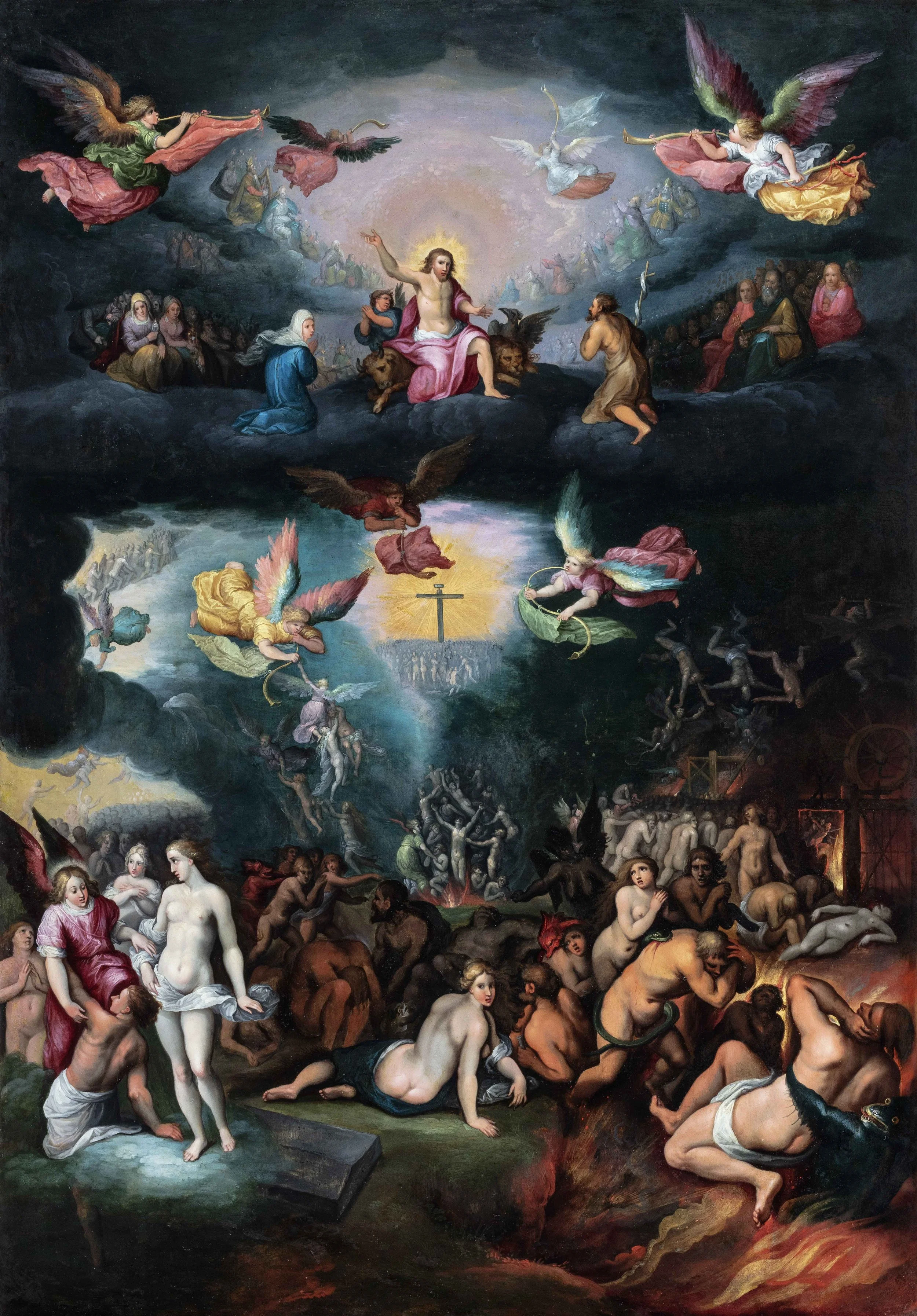
PETER LISAERT IV (Antwerp 1595 – Antwerp 1629)
The Last Judgement
stamped on the reverse with the platemaker’s mark K W
oil on copper
34 x 24 inches (86.4 x 70 cm.)
PROVENANCE
Anonymous sale, Sotheby’s Parke – Bernet, New York, June 7, 1978, lot 214, (as attributed to Hans Rottenhammer) where acquired by
Private Collection, Massachusetts until the present time
EXHIBITED
Smith College Museum of Art, Northampton, Massachusetts
It is the last day on Earth. Christ sits in judgment surrounded by the Court of Heaven. Angels of the Apocalypse awaken the dead with the sound of long trumpets. On the left side the risen guided by angels ascend towards Heaven while on the right devils herd the damned downwards into the hellfire. It is the final separation of all humanity into salvation or eternal damnation.[1] In the center of the composition the Cross emanates light reminding the viewer that “light always triumphs over darkness”.[2] Lisaert presents an utterly wild scene filled with writhing bodies, anthropomorphic demons and angels awash in Mannerist colors. At “a time when the belief in Hell was absolute”[3] the work is meant to strike terror and hopefully repentance in the viewer.
Christ reigns on black clouds above the fray with an upraised right hand and a depressed left where the stigmata is quite visible. The symbols of the Four Evangelists surround him, the angel represents Matthew, the ox Luke, the eagle John, and the lion Mark. The Virgin kneels to his right while John the Baptist is on his left. The surrounding Court consists of the Apostles, prophets, saints, martyrs and patriarchs. St. Peter who holds the keys of Heaven always appears first on the right side of the Court.[4] Fascinatingly the resurrected all seem to be about the same age where “the bodies belong to the period in life where one has ceased to acquire strength and not begun to lose it”.[5] In the foreground and center, angels and devils divide the saved from the damned. While apprehension fills the yet to be chosen, the condemned sorrowfully recount their deadly sins (pride, greed, lust, envy, gluttony, wrath, and sloth). In the rendering of the devils, Lisaert took the idea of the devil comes in many forms quite literally, creating a small army of grotesques. Only the fate of the lovely young woman in the center foreground remains unknown. Her gaze directly engages the viewer, which sends an unmistakable warning.
Peter Lisaert IV was a member of a dynasty of painters and dealers who settled in Antwerp around 1520 and spanned five generations. His father was Philips Lisaert III and his mother Suzanna Bernoille. He became a master in the Antwerp Guild of St Luke in 1615 and was only active for slightly less than 14 years. It is unknown if he had a studio or pupils, with few works recorded in contemporary inventories. A different composition by Lisaert of The Last Judgement is in the Musée des Beaux-Arts in Dijon which replicated a Frans Francken II of The Last Judgement known to have been owned by his mother.[6] Similarly our painting reproduces yet another Last Judgment by Francken (oil on copper, 73.5 x 51 cm., signed and dated 1609, see Ursula Härting, Frans Francken II, Luca Verlag Freren, 1989, pp. 276-277, no.175). Thus, the connection between the two large families of artists working at the same time in Antwerp is firmly established yet to what extent they interacted remains unknown.
An additional mystery is the platemaker’s mark K Won the reverse of the copper, whose craftsman’s identity is untraceable. A mark not often seen, it consists of the letters K W encircled by a ring of pearls with a small rosette of seven pearls above the monogram.[7]
We are grateful to Dr. Ursula Härting for identifying the work as that of Peter Lisaert IV.
[1] “The Last Judgement” at Vatican Museum on museivaticani.va>giudizio-universale.
[2] Dr. Chris Aiken, “Light, The Cross and Renewed Purpose”, February 26, 2017, at chrisaikenonline.com.
[3] Robert Hughes, Heaven and Hell in Western Art, Stein and Day, New York, 1968, p. 43.
[4] Mrs. Jameson, The History of our Lord as Exemplified in Works of Art, volume II, Longmans, Green & Co., London, 1892, pp. 134, 136, 393, 398, & 401.
[5] Ibid, p. 406.
[6] U. Härting, “Peter Lisaert IV” in Allgemeines Kunstlerlexikon: Die Bildenden Kunstler aller Zeiten und Valker, volume 85, 2025.
[7] Jorgan Wadum, Copper as Canvas, Two Centuries of Masterpiece Paintings on Copper 1575 – 1775, Oxford University Press, Oxford, 1999, pp. 107-108.