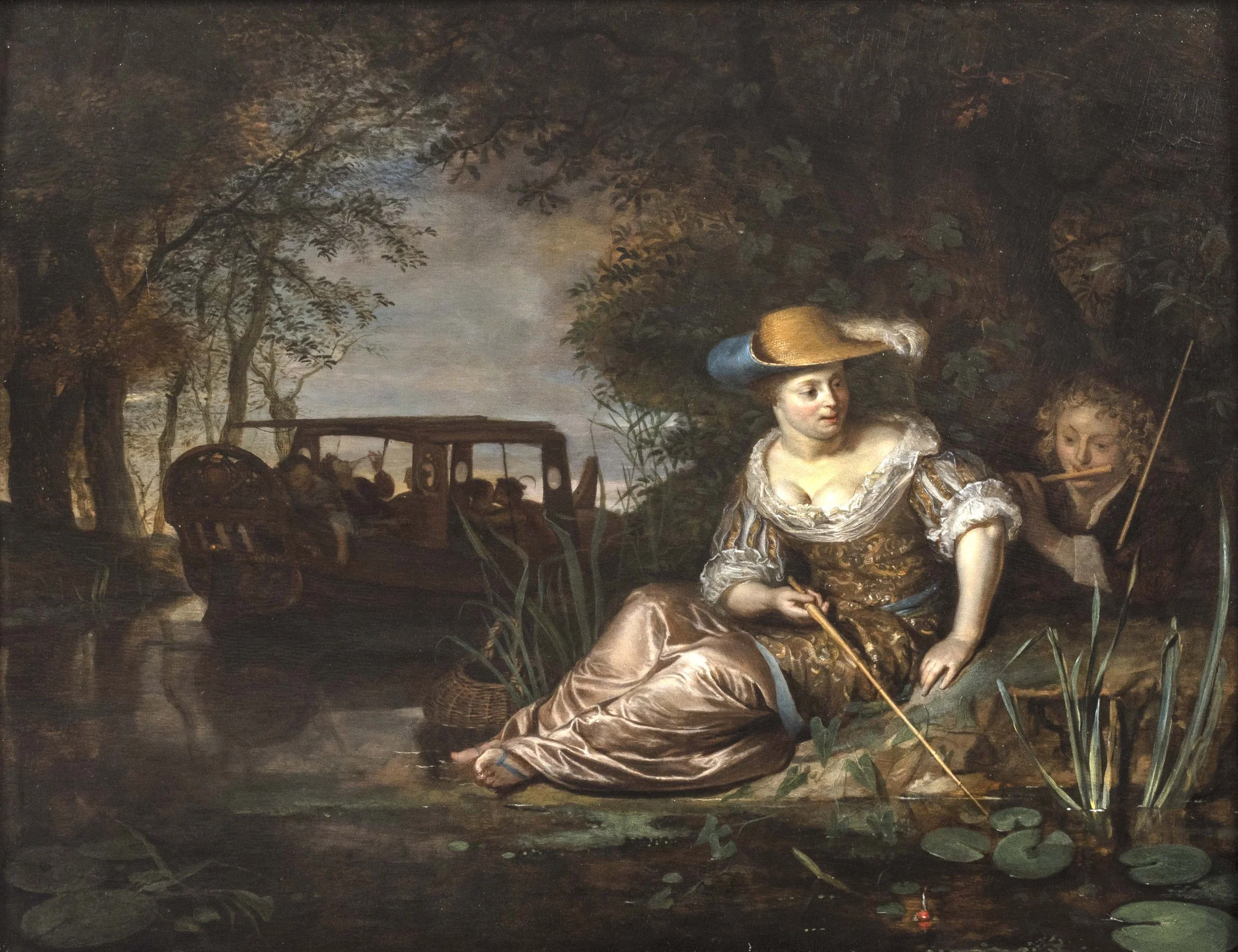
CAREL DE MOOR (Leiden 1655 – Warmond 1738)
The Pleasure of Fishing (Le Plaisir de La Pêche)
signed CA…DE MOOR on the stern of the ferry boat and to the right of the rudder
oil on panel
12.6 x 16.1 inches (32 x 41 cm.)
PROVENANCE
Chevalier Antoine de la Roque, E. F. Gersaint, Paris, April 1, 1745, lot 181, (“Un Joli Tableau” [a pretty picture]) where purchased by
Louise Antoine Crozat, Baron de Thiers (1699 – 1770)
Count Heinrich von Brühl, Saxony (1700 – 1763)
Antoine Poullain sale, J. B. P. Le Brun, Paris, March 15, 1780, lot 88, (“Ce tableau est d’une fort belle harmonié… Il a été peint en 1679” [This painting is beautifully harmonious … It was painted in 1679]) where sold to
Alexandre – Joseph Paillet (1743 – 1814)
Anonymous sale, Chayette & Cheval, Paris, October 22, 1999, lot 33
Kunsthandel P. de Boer, Amsterdam by 2016
LITERATURE
Michel Huber & J.G. Stimmel, “Charles de Moor” in Catalogue Raisonné du Cabinet D’ Estampes de feu Monsieur Winckler, volume 3, Leipzig, 1805, p. 600, no. 3281, (references the print)
M. Bérnard, “Charles de Moor ” in Cabinet de M. Paignon Dijonval, De L’Imprimerie de Madame Huzard, Paris, 1810, p. 189, (references the print )
Dr. G. K. Nagler, “Karel de Moor” in Neues Allgemeines Künstler – Lexicon oder Nachrichten, volume 5, E. A. Fleischman, Munich, 1840, p. 441, (refernces the print)
Charles Le Blanc, “Elie du Mesnil” in Manuel de l’Amateur D’Estampes, volume 3, P. Jannet, Paris, 1854, p. 17, (refernces the print)
Pierre Larousse, “Pêche à la Ligne” in Grand Dictionnaire Universal [du XIX Siècle] Français A-Z, Administration du Grand Dictionnaire Universal, Paris, 1874, p. 477, (refernces the print)
Baron Roger Portalis & Henri Beraldi, “Elie Mesnil” in Les Graveurs du Dix – Huitième Siècle, volume 3, Damascène Morgand & Charles Fatout, Paris, 1882, p. 83, (refernces the print)
H. Mireur, “Karel de Moor, De La Roque, 1745” in Dictionnaire des Ventes D’Art Artistiques, Maison d’Editions D’Oeuvres, Paris, 1911, p. 260
F.W.H. Hollstein, “Carel de Moor” in Dutch and Flemish Etchings, Engravings and Woodcuts c. 1450 – 1700, volume 14, M. Hertzberger, 1949, p. 86, (references the print)
Pamela Fowler & Piet Bakker, Carel de Moor,1655 – 1738, His Life and Work, A Catalogue Raisonné, Primavera Pers, Leiden, 2024, pp. 122-123, no. NPA 19, illustrated; p. 232, no. NPA 19, illustrated; p. 170, fn. 71
EXHIBITED
Dordrecht, Dordrechts Museum, Schalcken – De Kunst van het verleiden (Schalcken – The Art of Seduction), February 21 – June 26, 2016
ENGRAVED
Elie Dumesnil, circa 1764
Carel de Moor was the son of Carel de Moor I, an ebonist who specialized in frames, and Magdalena de Ridder. He began his training with Gerrit Dou, circa 1666 – 1667. Probably around 1670 he moved to Amsterdam to study with Abraham van den Tempel. After the death of Van den Tempel in 1672, De Moor returned to Leiden and continued his instruction with Frans van Mieris. He later moved to Dordrecht where he came into contact with Godfried Schalcken. In 1688 he married Hillegonda Wael with whom he had six children including Carel Issac, who also became a painter. By 1683 he had joined the Leiden Guild and soon became so successful[1] that “during his lifetime he was considered one of the greatest Dutch painters.”[2] De Moor painted portraits, genre and historical scenes. His most famous sitter was the Tsar of Russia, Peter the Great painted in 1717. He received international acclaim for his portraits for which there was a tremendous demand. Surprisingly though in a career that spanned around sixty years there are only 35 genre scenes known to exist.[3]
The purported date for The Pleasure of Fishing is 1679 as recorded in the Paris auction catalog of 1780. If correct the date is no longer visible, but in any case the painting stems from the early part of De Moor’s career.[4] In this work set on a riverbank at twilight, an exquisitely dressed young woman is fishing while a young man nearby plays a flute. In the background a party boat with revelers glides by in which a couple kisses, others party with another woman slumped over the side of the boat. Incongruous with the overall tranquility of the scene and physical refinements of the protagonists, the boat’s occupants are meant as a warning. In the seventeenth century fishing scenes with men were popular in art and often carried explicit erotic overtones.[5] Cloaked in the elegance of a highly polished technique, undoubtably learned from the Leiden – Fijnschilders the role reversal takes on a slightly different interpretation with the young woman fishing instead for love.[6] Yet the playing of a flute was thought to have sexual innuendos, and although sublimated the meaning remains clear.
[1] Pamela Fowler, op.cit., pp.15, 21-22, 34; and Written communication from Pamela Fowler dated May 11, 2026.
[2] Wayne Frantis, Dutch Seventeenth – Century Genre Painting, Yale University Press, 2004, p. 230.
[3] Wayne Frantis, op.cit., p. 232 ; Pamela Fowler, op.cit., p. 24 ; and Written communication from Pamela Fowler op.cit.
[4] Pamela Fowler, op.cit., pp. 122, 232.
[5] Wayne Frantis, op.cit., p. 232 ; and Pamela Fowler, op.cit., p. 122.
[6] Michael P. Branch, Reading the Earth – New Directions in the Study of Literature, University of Idaho Press, 1998, p. 57.