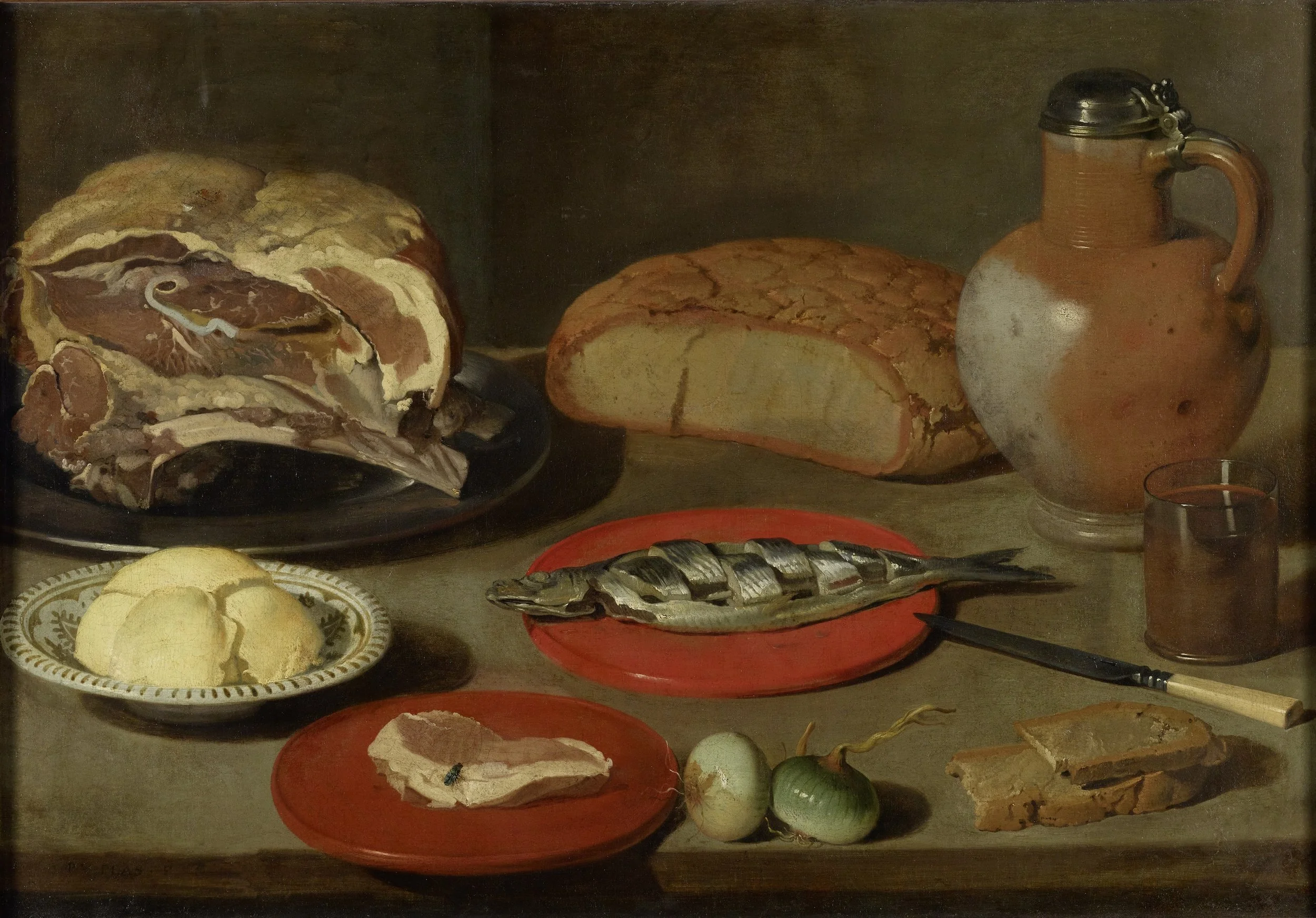
P... V... PLAS (Flourished first half of the Seventeenth Century)
Peasant Breakfast
signed in the lower left along the table edge P. V. PLAS. F.
oil on canvas
23.4 x 33.6 inches (59.5 x 85.3 cm.)
PROVENANCE
Private Collection, Rhineland-Westphalia, until c. February 1936
Galerie Stern, Düsseldorf, by February 1936 from whom acquired by
Hugo Heinemann, Düsseldorf, c. 1936 until confiscated on July 2,1937 after his arrest by the Gestapo
Confiscation and administration by the trust company Altenburg und Tewes, Düsseldorf, July 2, 1937 - November 26, 1940, who consigned it to
“Non-Aryan ownership”, Kunsthaus Lempertz, Cologne, November 26, 1940, lot 81, illustrated, where bought by
Rheinisches Landesmuseum Bonn (inventory no. 1941.2), November 26, 1940 - November 14, 2025, when restituted in equal parts to
Dr. & Mrs. Max Stern Foundation and the heirs of Hugo Heinemann
LITERATURE
Düsseldorf, Galerie Stern, Gëmalde Alter Meister aus Rheinisch-Westfälischem Privatbesitz, February 24 – March 31, 1934, no. 57
Verzeichnis über das Vermögen von Juden nach dem Stand vom 27. April 1938 (Register of Jewish Assets as of April 27, 1938)
Kunsthaus Lempertz, Cologne, Dr. Krüger, Meran und anderer Besitz, November 26-29, 1940, lot 81, plate 26
Franz Rademacher, “P. van Plas” in Verzeichnis der Gemälde Rheinisches Landesmuseum in Bonn, Böhlau – Verlag, Cologne, 1959, p. 34
Fritz Goldkuhle, Ingeborg Krueger, & Hans M. Schmidt, “Pieter van (der) Plas” in Rheinisches Landesmuseum Bonn, Gemälde bis 1900, Rheinland Verlag GmbH, Cologne, 1982, pp. 410 – 411, illustrated
Edith Greindl, “Pieter van der Plas” in Les Peintres Flamands de Nature Morte au XVIIe Siècle, Editions d’Art Michel Lefebvre, Sterrebeek, 1983, p.165
Claus Grimm, “Pieter van der Plas (Plassen?)” in Stilleben: Die niederlandischen und deutschen Meister, Besler Verlag, Stuttgart, 1988, p. 240
Harald Tausch, ed., Historismus und Moderne, Ergon, Würzburg, 1996, p. 227
Adriaan van der Willigen & Fred G. Meijer, “P... V... Plas” in A Dictionary of Dutch and Flemish Still – Life Painters Working in Oils 1525 – 1725, Primavera Press, Leiden, 2003, p. 162
Fred G. Meijer, “P… V… Plas” in Fish, Still Lifes by Dutch and Flemish Masters 1550 – 1700, Centraal Museum, Utrecht, 2004, p. 420
Dr. Christiane Fricke, “Nazi – looted art and its victims: the state of research on Max Stern” in Handelsblatt on lootedart.com, March 3, 2022
“P. V. Plas, Bäuerliches Frühstück” in Augenlust? Niederländische Stilleben Im Detail, LVR – Landesmuseum Bonn, 2022, pp. 86-87, no. 4, detail illustrated; pp. 90 – 91, no. 4, illustrated; p. 97, no. 4, detail illustrated
“LVR – Landesmuseum, Bonn, “Eye Candy? Dutch Still Lifes in Detail” in Beethoven – Bilder – Bibliotheken at Heidelberg University on ahnp.ub.uni-heidelberg.de, January 2023, p. 62, no. 6, illustrated
“Mystery surrounding Nazi – looted art” at General Anzeiger, ga.de, January 10, 2023, illustrated
Eve Marie Lehner, “Augenlust? Niederländische Stilleben im Detail”, at Research Gate, researchgate.net, February 2024, p. 2
“Advisory commission in connection with the return of the cultural property confiscated as a result of Nazi persecution in particular from Jewish ownership, In the case of Dr. and Mrs. Max Stern Foundation v. Landschaftsverband Rheinland and Heirs of Hugo Heinemann v. Landschaftsverband Rheinland” at lootedart.com, November 18, 2025
“LVR – Landesmuseum Bonn restituiert niederländisches Stilleben von P. V. Plas” at LVR – Landesmuseum Bonn at landesmuseum – bonn - vr.de, November 18, 2025, illustrated
Dr. Christiane Fricke, “Nazi – looted art, Advisory Commission – its last case” in Handelsblatt at handelsblatt.com, November 18, 2025, illustrated
“Amicable settlement through mediation by the Advisory Commission” at German Lost Art Foundation, Kulturgutverluste.de > news, November 18, 2025
“Restitution in Germany” at provenance.international, November 18, 2025
“Arbitration of Nazi – looted art, Dr. and Mrs. Max Stern Foundation v. Rhineland Regional Association and heirs of Hugo Heinemann v. Rhineland Regional Association” at Schiedsgerichtsbarkeit-ns –raubgut.de, November 18, 2025
“Bonn Museum returns painting to heirs of Jewish owners” at Evangelische Zeitung, evangelische – zeitung.de >., November 19, 2025
“LVR Museum returns painting to Jewish heirs” at WDR, 1.wdr.de, November 19, 2025
“LVR-Landesmuseum Bonn restitutes Dutch still life by P. V. Plas” at lifePR, lifepr.de > boxid, November 19, 2025
“Bonn Museum returns painting to heirs of Jewish owners” at Jüdische Allgemeine, juedische-allgemeine:de, November 19, 2025, illustrated
“An Obvious Conflict of Interest” in Monopol Magazin für Kunst und Leben at monopol-magazin.de, November 19, 2025
Ulrich Raphael Firsching, “Bonn Museum restitutes Dutch still life” at Kunstmarkt.com, November 21, 2025, illustrated
“Hugo Heinemann” at Provena, Datenbank Provenienzforschung, Deutsches Zentrum Kulturgutverluste, December 12, 2025
“Germany’s Advisory Commission on Nazi – Looted Art brokers unprecedented agreement between museum and heirs of Jewish dealer and Jewish client” at Concordia University, concordia.ca, December 18, 2025, illustrated
“Concordia University: Germany’s Advisory Commission on Nazi – Looted Art Brokers unprecedented agreement between museum and heirs of Jewish dealer and Jewish client” at Education News Canada, educationnewscanada.com, January 5, 2026, illustrated
“Provenance Watch, Weekly Roundup”, at provenancewatch.substack.com, January 11, 2026, illustrated
EXHIBITED
Düsseldorf, Galerie Stern, Gemälde Alter Meister aus Rheinisch-Westfälischem Privatbesitz, February 24 – March 31, 1934, no. 57
Bonn, LVR – Landesmuseum, Augenlust?: Niederländische Stilleben im Detail, September 22, 2022 – February 19, 2023, no. 4
A Peasant Breakfast by P. v. Plas is the only known fully signed example by the artist and is regarded as the best work in his small oeuvre.[1] Since 1940 it had been part of the permanent collection of the Rheinisches Landesmuseum Bonn when acquired at Kunsthaus Lempertz of Cologne in an auction that featured confiscated property of “non-Aryans”. The owner of the P. v. Plas was Hugo Heinemann, a Jewish Düsseldorf businessman who had purchased the painting from Galerie Stern, owned by the Jewish art dealer Dr. Max Stern, also in Düsseldorf in 1936. At the time of the Lempertz sale Heinemann was in the “Ulmer Höh” a Düsseldorf Gestapo prison.[2] Their personal stories and the historic decisions that enabled the painting’s restitution deserves to be told in order that we “never forget”.[3]
In 1934 Dr. Max Stern (1904 – 1987) inherited the Galerie Julius Stern in Düsseldorf from his father.[4] By 1935 Dr. Stern was prohibited by the Reich Chamber for the Visual Arts from buying and selling art, with the final blow delivered in 1937 when ordered to immediately liquidate his entire stock. In compliance with this order, 228 paintings were sold in an auction on November 13, 1937, at Lempertz in Cologne. On December 23, 1937, Dr. Stern fled to Paris and from there to London, where he opened a small gallery with his sister, called West’s Galleries. In May 1940, he was interned in England as a “dangerous alien,” along with many other German and Austrian refugees. After three months he had the opportunity to emigrate to Canada. Once there he wound up in internment camps until 1942. Remarkably Dr. Stern was able to rebuild his life when given a job at the Dominion Gallery in Montreal, which eventually he would come to own, and rise to be one of Canada’s leading art dealers. Sadly, he suffered a fatal heart attack in 1987 while on a business trip to Paris. Shortly after the end of the war, Dr. Stern began searching for the paintings from the forced auction at Lempertz, a task that was later taken over by the Dr. and Mrs. Stern Foundation and continues to this day.[5]
Hugo Heinemann (1900–1943) was a partner, along with his father and his brother Fritz, in the import-export firm Joseph Heinemann KG. His brother Walter managed the Hamburg branch. Hugo Heinemann was a regular customer of Galerie Stern, where he purchased the still life by P. van Plas in 1936. While his two brothers fled to the Netherlands, Hugo Heinemann remained in Düsseldorf with his wife and two daughters. In March 1937, he was arrested on charges of alleged foreign exchange violations; his trial followed in July, at the conclusion of which Hugo Heinemann was sentenced to six years in prison, six years of loss of civil rights, and a fine of 1.15 million RM. His family and parents also fled Germany. After serving his prison sentence, Hugo Heinemann was taken to the Auschwitz extermination camp and murdered there on February 16, 1943.[6]
The settlement for the return of the P. v. Plas from the Rheinisches Landesmuseum Bonn, brokered by Germany’s Advisory Commission on Nazi-Looted Art, was unprecedented due to the recognition that both Max Stern and Hugo Heinemann were equally wronged as victims of Nazi persecution. Previously the original owner, in this case Max Stern, would have been viewed as the primary victim and rightful owner. But in this case the Commission felt that “restitution to the primary victim was not consistent with the 1998 Washington Principals on Nazi Confiscated Art, which recommends a fair and just solution for all victims of National Socialist policies”.[7] In the end co-ownership was granted to both wronged parties, the Stern Foundation and the heirs of Hugo Heinemann.
The full identity of the painter P. v. Plas remains a mystery. Edith Greindl in her landmark work Les Peintres Flamands de Nature Morte au XVIIe Siècle concluded that the portrait painter Pieter van der Plas who worked in Brussels from 1619 to after 1646 was a different artist, which is widely accepted. She further noted that a painter called Pieter van de Plassen worked in Brussels at about the same time and registered there in 1636 as born near Alkmaar.[8] Yet nothing is conclusive.
Titled a Peasant Breakfast, this work belongs to still lifes called onbijtjes or breakfast pieces. Such works present “a peak into the daily lives of the seventeenth century Dutch” and tend not to emphasize social commentary. The painting’s brown bread at once marks the table as that of the working class.[9] From a high vantage point on roughly hewn wood, food and drink have been laid out in a circle with a glittering sliced herring on a vermillion earthenware plate in the center. Behind the herring is a sliced loaf of bread and next to it a Raeren stoneware jug with a pewter lid. In front of it is a beaker filled with dark beer. Beer was commonly drunk at all meals and regarded as a safe substitute to often contaminated drinking water. Of low alcoholic content it was seen as a nutritional staple and even suitable for children.[10] Next to the glass is a knife with an ivory handle, two cut pieces of bread and then two onions. Extended over the edge of the table is a brick red earthenware plate with a slice of pork, its positioning a device to add to the overall effect of three dimensionality.[11] To its left is a simple faience plate with butter which is in front of a pewter plate with a pork rib. Through an economy of means P. v. Plas pays tribute to the inherent beauty of a simple meal characterized by brilliant local colors and a well-balanced composition. The painting’s sole vanitas element is the fly in the foreground which hints at the impermanence of the food that mirrors the transient nature of all earthly pleasures. [12]
We are indebted to Dr. Fred G. Meijer for his invaluable assistance in the writing of this entry.
[1] Written communication from Dr. Fred G. Meijer dated August 7, 2025.
[2] Hildegart Jakobs: Hugo Heinemann. – In: Gedenkbuch Düsseldorf (https://gedenkbuch duesseldorf.de/memory-book/heinemann-hugo/ )
[3] “Never Forget” is a motto synonymous with Holocaust remembrance and education”. Yad Vashem at www.yadvashem.org.
[4] Dieter Vorsteher: Die Geschichte der Familie Stern und ihrer Kunsthandlung. – In: Der Kunsthändler Max Stern. [Katalog zur Ausstellung im Stadtmuseum Düsseldorf, 2.9.2021-30.1.2023]. Köln 2021, S. 16-79.
[5] Written communication from Dr. Willi Korte dated September 22, 2026.
[6] Ibid.
[7] “Germany’s Commission on Nazi Looted Art brokers unprecedented agreement between museum and heirs of Jewish dealer and Jewish client”, Concordia University, op.cit.
[8] Adriaan van der Willigen & Fred G. Meijer, op.cit., p. 162.
[9] Heather Arndt Anderson, Breakfast, Rowant Littlefield, Plymouth, 2013, p. 170.
[10] Fritz Goldkuhle, op.cit., p. 410; and Jonathon Janson “Food in the Netherlands” on Essential Vermeer at essentialvermeer.com.
[11] Peter C. Sutton, Dutch and Flemish Paintings, The Collection of Willem Baron van Dedem, Frances Lincoln Limited, London, 2002, p. 147.
[12] “Ontbijt, c. 1615 – 1620” at Kröller-Müller Museum at krollermuller.nl.