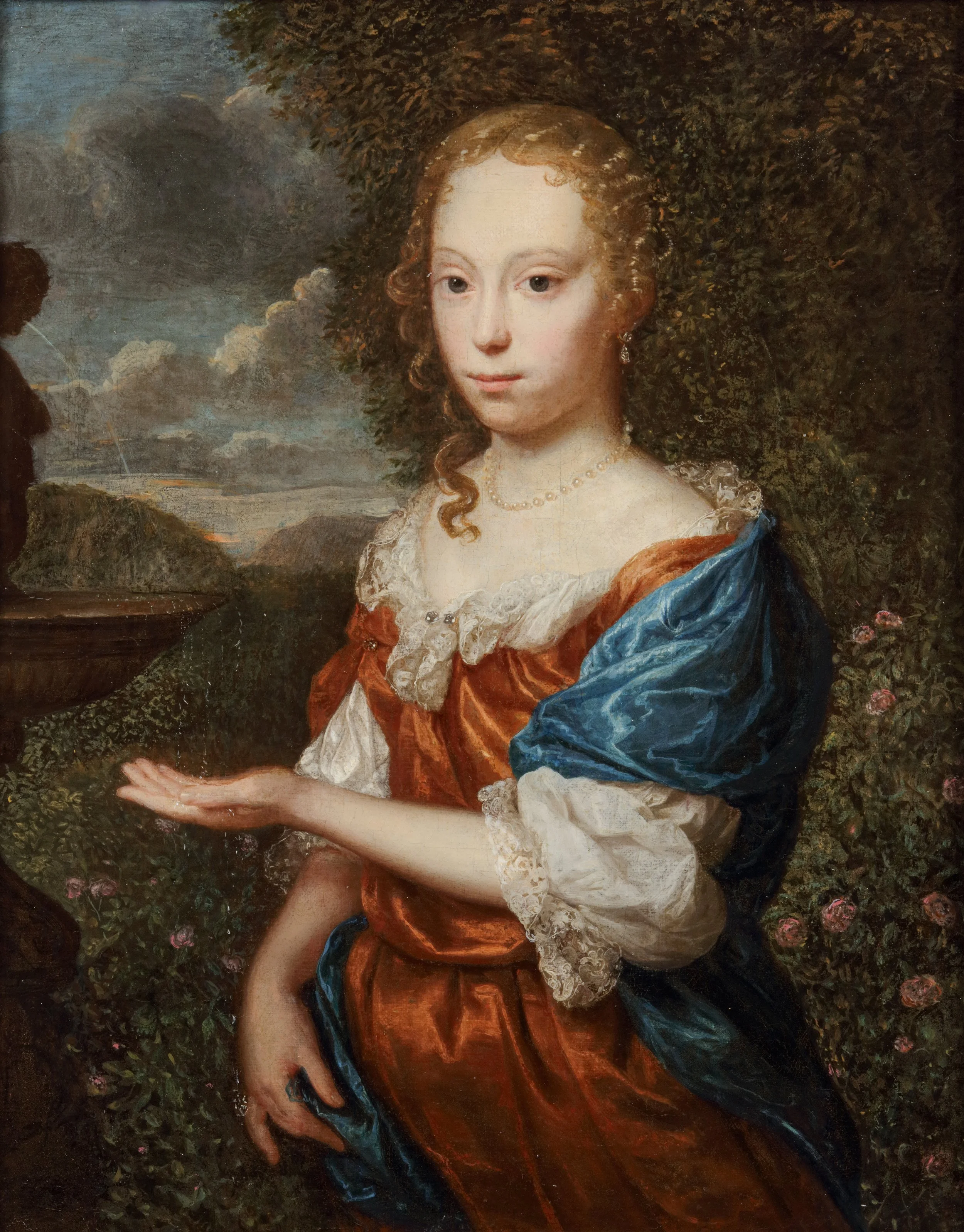
CIRCLE OF GODFRIED SCHALCKEN
A Betrothal Portrait
oil on canvas
16.5 x 13.4 inches (42 x 34 cm.)
A young lady stands in a garden at twilight before a hedge of pink roses next to a spouting fountain. She is exquisitely dressed In an orange silk gown, a white chemise trimmed with lace, and a blue cloak. She wears a pearl necklace with one pearl earring visible. Her hair is fashionably styled in ringlets. The time is the last quarter of the seventeenth century in the Netherlands.
The significance of the abundance of pink roses that surround the sitter is that they symbolize love, grace, gentleness and admiration. Their very light shade represents innocence and youthfulness.[1]
Her pearls are indicative of virtues that were expected of a bride, purity and chastity. Similarly the gesture of holding her right hand under the fountain’s flowing water also points to her purity.[2]
Fountains from the 1650s on became a regular feature of large Dutch gardens and became a popular emblem particularly in female portraits.[3] The garden setting added further to the status of the bride as such imagery was intended to suggest her family’s ownership of a country estate.
A sunset is depicted in the far distance. By painting the light in these works to reflect twilight the suggestion of tranquility and the antique were heightened. The inclusion of a reference to antiquity at this time stemmed from the popularity of pastoral literature, which presented a vision of Arcadia as paradise ruled by Pan, inhabited by nymphs, satyrs, shepherds, dryads and other acolytes dedicated to the pursuit of love. It suggested a perfect world free of the mundane tribulations of daily life,[4] and perhaps the blissful state of her future marriage.
[1] Anuska, “Pink Roses: Their History, Meaning and Significance” at fnp.com, July 3, 2023.
[2] E. de Jongh, Portretten van echt en trouw, huwelijk en gezin in de Nederlandse Kunst van de zeventiende eeuw, Wanders, Zwolle, 1986, pp. 189 – 190.
[3] Ibid, p. 54.
[4] James Hall, “Arcadia” in Dictionary of Subject and Symbols in Art, Harper & Row Publishers, New York, 1979, pp. 30-31; Scott A. Sullivan, The Dutch Gamepiece, Rowmant & Allenheld Publishers, Totowa, New Jersey, 1983, pp. 62-63; and Alice McNeil Kettering, The Dutch Arcadia. Pastoral Art and its audience in the Golden Age, Totowa, New Jersey,1983, pp. 10-11, 70-71.