A SIMPLE BREAKFAST, AN EXTRAORDINARY STORY
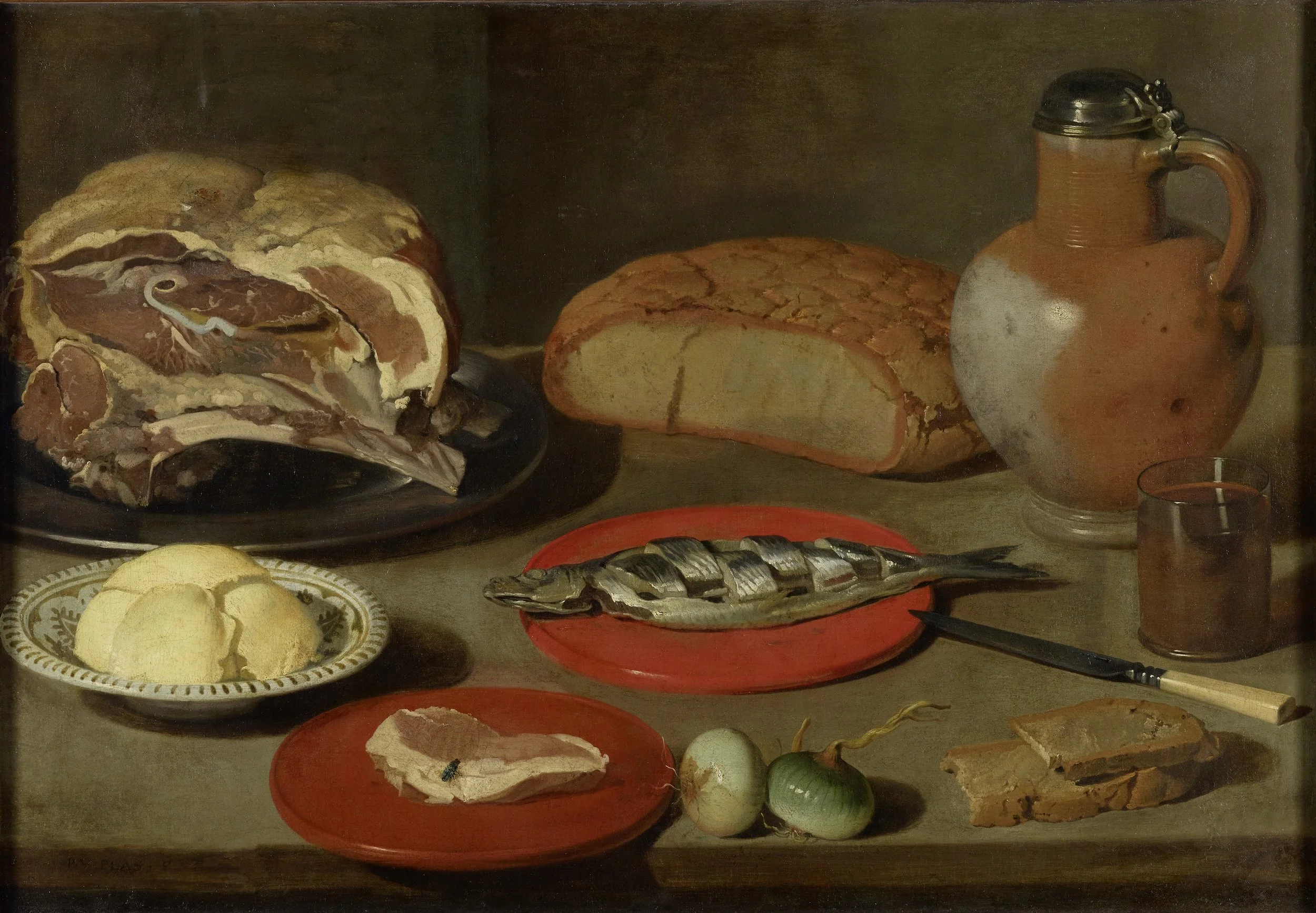
At first glance, there is nothing particularly remarkable about this meal. A loaf of crusty bread has been cut open. A diced herring sits on a bright red plate alongside butter, pork, a couple of onions and a glass of beer. It is a simple meal, but there is something familiar about it. It feels as though someone has just stepped away from the table and might return at any moment.
Painted in the first half of the seventeenth century by the artist known only as P. v. Plas, Peasant Breakfast belongs to a tradition of still lifes known as ontbijtjes, or breakfast pieces. There is no silver or fine porcelain here. The brown bread tells us this is a modest table, but that does not make it any less beautiful. The artist seems to delight in the everyday: the silvery skin of the herring, the thick crust of the bread, the creamy butter and the flashes of brilliant red.
Look closely and you will even find a tiny fly sitting on the slice of pork in the foreground. It is easy to miss, but it carries a familiar seventeenth century message. Food spoils, meals end and the pleasures of life do not last forever. Knowing the journey this painting would eventually take makes that tiny detail feel especially poignant.
By 1936, the painting was with Galerie Stern in Düsseldorf, run by the Jewish art dealer Dr. Max Stern. That year it was bought by Hugo Heinemann, a Jewish businessman who was a regular client of the gallery. Neither man could have known how quickly the world around them was about to change.
Stern was forced by the Nazis to liquidate his gallery in 1937 and fled Germany. After a difficult journey through England and internment in Canada, he managed to rebuild his life and career, eventually becoming one of Canada's leading art dealers. Hugo Heinemann's story was sadly different. He was arrested by the Gestapo in 1937 and his business and possessions were confiscated. His wife Gustl and their two daughters managed to escape and survived the war. Hugo did not. He was deported to Auschwitz and murdered there in 1943.
This simple breakfast became part of that history too. Confiscated following Heinemann's arrest, it was sold at Kunsthaus Lempertz in Cologne in 1940 and acquired by what is now the LVR Landesmuseum Bonn, where it remained for more than eighty years.
Its eventual restitution raised a complicated and deeply human question. What happens when the stories of two people persecuted by the Nazis become connected to the same painting?
The answer was unusual. Rather than allowing one history to overshadow the other, for the first time, an agreement reached through Germany's Advisory Commission on Nazi Looted Art recognised the losses suffered by both Max Stern and Hugo Heinemann. In November 2025, Peasant Breakfastwas restituted jointly to the Dr. & Mrs. Max Stern Foundation and the heirs of Hugo Heinemann.
There is something quietly hopeful in that. The work of the Stern estate has helped ensure that the history surrounding this painting is remembered, while also bringing Hugo Heinemann and his family's story back into the light.
And perhaps that is what makes this otherwise humble painting so moving today. Nearly four hundred years later, the bread is still on the table, the herring still looks shiny and fresh, and the tiny fly is still there, reminding us how fleeting life can be.
The painting survived. And with it, so did the stories of the people whose lives became part of its own.
30 September 2026